
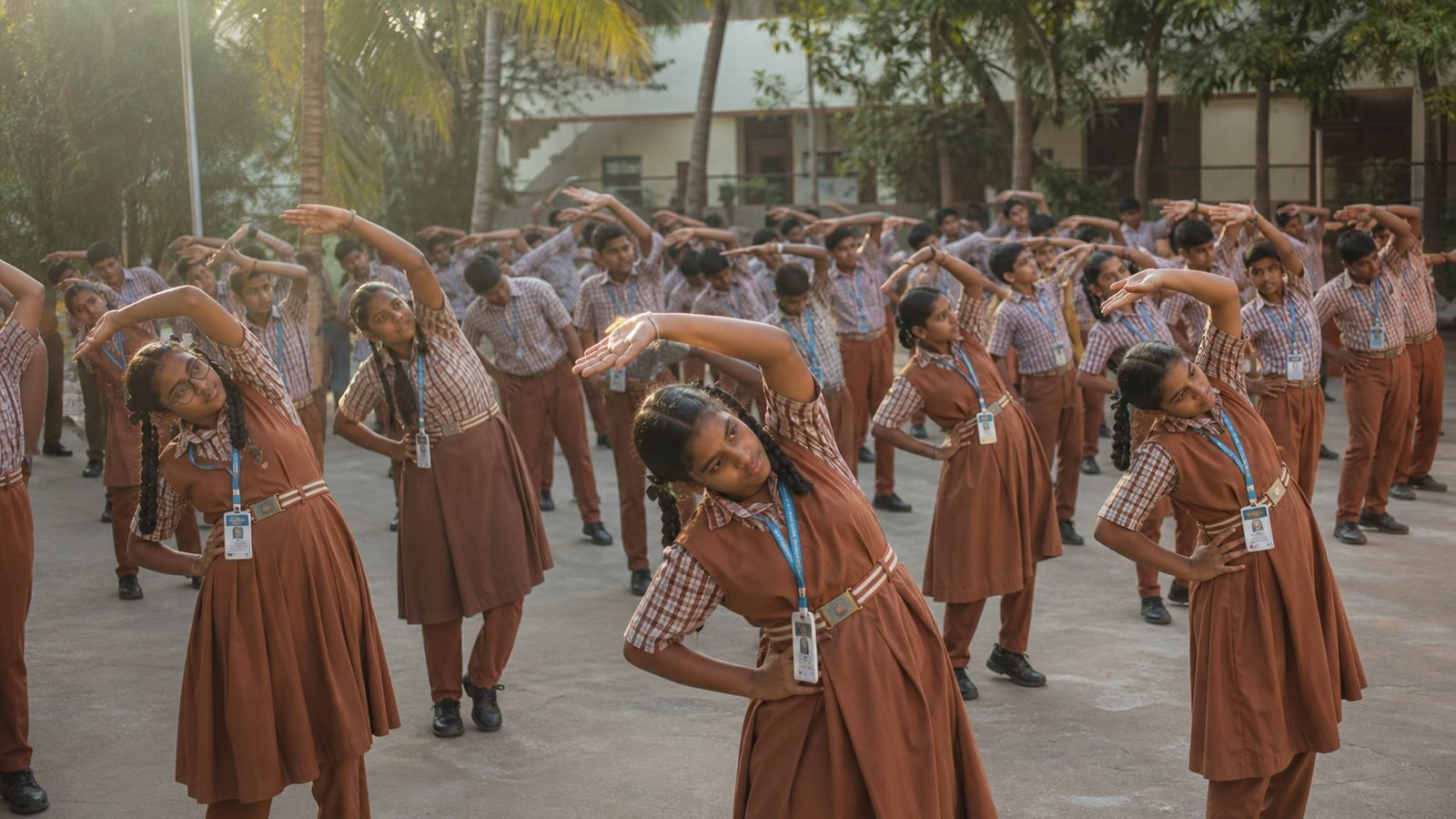
Every morning in the Kranthi courtyard, before the first bell rings, rows of students move through their physical drill under the palms. To a passer-by it may look like simple exercise. To us, it is one of the most important lessons of the day — one that no textbook can teach.
Physical education is sometimes treated as a break from "serious" learning. Our experience over three decades says otherwise. The playground is a classroom of its own, and the lessons learned there — discipline, resilience, teamwork, and grace in both victory and defeat — shape students for life.
Discipline You Can Feel
Academic discipline is abstract for a young child; physical discipline is not. Arriving on time for drill, holding a position, repeating a movement until it improves — these are concrete, daily experiences of effort and routine. Students who internalise this rhythm carry it into their studies. The same patience that improves a long jump improves a mathematics problem: attempt, review, correct, repeat.
Resilience Is Built, Not Born
Sport delivers something classrooms carefully avoid: frequent, low-stakes failure. A dropped catch, a lost race, a missed goal — each one stings for a moment and teaches for much longer. Children learn that failure is information, not identity. They learn to lose without despair and to win without arrogance. When examinations eventually bring pressure of their own, students who have competed on the field already know how to steady their nerves and try again.
Teamwork Cannot Be Memorised
Group games force skills that no amount of instruction can substitute: reading teammates, communicating quickly, trusting others with a shared outcome, and putting the team's success above personal glory. On our Sports Day, the loudest cheers are rarely for the fastest runner — they are for the relay teams, where four students succeed or fail together. These are precisely the collaboration skills that modern workplaces prize, learned years before a résumé is ever written.
Healthy Bodies, Ready Minds
The connection between physical activity and academic performance is well established. Exercise improves concentration, memory, sleep, and mood. A child who has run, stretched, and played sits down to study with a settled mind. This is why physical education at Kranthi is scheduled deliberately, not squeezed in as an afterthought — movement is part of how children learn, not a pause from it.
Every Child on the Field
Our sports programme is not built around producing a few champions; it is built around including every child. Yoga sessions teach stillness and breath. Athletics teach personal progress — competing against yesterday's self. Team games teach belonging. Annual Sports Day gives every student, from Nursery to Class X, a moment on the field in front of their cheering schoolmates.
Marks will always matter, and we hold our academic standards high. But when our alumni look back, many of their strongest memories — and several of their most useful habits — were formed not at a desk, but on the ground, in the morning sun, learning lessons that last a lifetime.
See Sports Day in the Gallery Back to Blog