
Ask any experienced teacher where a confident Class X student was made, and the answer may surprise you: long before Class I. The years between Nursery and U.K.G. are the single most formative period in a child's development. During this window, the brain forms neural connections at a pace it will never match again — laying the architecture for language, reasoning, emotional balance, and social behaviour that every later stage of schooling builds upon.
This is why Kranthi Early Years treats the pre-primary classes not as a waiting room for "real school," but as the foundation on which everything else stands.
What Actually Develops in the Early Years
In these first years of schooling, children are doing far more than learning rhymes and recognising letters. They are developing spoken vocabulary and the listening skills that will later carry reading comprehension. They are learning to hold a pencil, cut along a line, and button a coat — fine motor skills that quietly prepare the hand for writing. They are discovering how to share, take turns, wait, ask, and apologise: the social grammar of the classroom.
Just as importantly, they are forming their first beliefs about themselves as learners. A child who experiences school as a warm, encouraging place carries curiosity and confidence into Class I. A child who experiences pressure and comparison too early may carry anxiety instead.
Play Is Not the Opposite of Learning
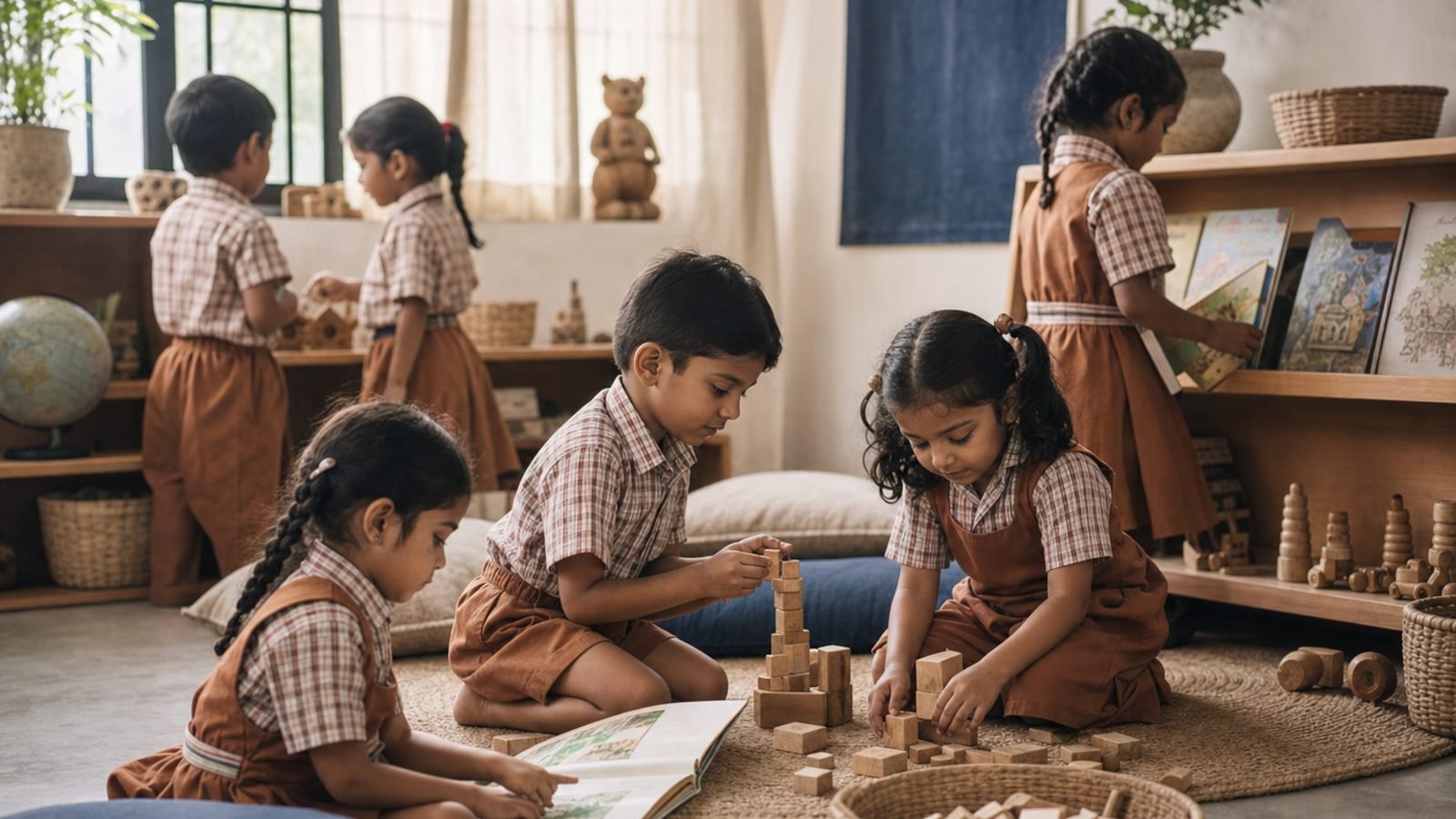
Parents sometimes worry when they see young children playing at school. The research — and three decades of our own experience — says the opposite: structured play is the curriculum at this age. Building blocks teach spatial reasoning and early mathematics. Pretend play builds language, imagination, and empathy. Group games teach rules, patience, and cooperation.
At Kranthi Early Years, activity-based learning is deliberately woven into each day. Children count real objects before they see written numerals. They hear and tell stories before they read them. They experiment with sand, water, colour, and clay because concrete experience is how young brains make sense of abstract ideas.
The Role of Safety and Routine
Young children thrive on predictability. A consistent daily rhythm — assembly, activity time, snack, story, play — gives them the security to explore. Our pre-primary classrooms are designed as safe, child-scaled spaces, and our teachers are chosen for their patience and warmth as much as their qualifications. For many children, a teacher at this stage is the first trusted adult outside the family; that relationship shapes how they see school for years.
What Parents Can Do at Home
The strongest early foundations are built when school and home pull in the same direction. Read to your child daily, in any language — the habit matters more than the medium. Talk with them constantly and answer their endless questions. Limit passive screen time and prefer real-world play. And resist the urge to compare; children bloom on different schedules, and nearly all of them bloom.
A Strong Start Lasts a Lifetime
By the time our children move from U.K.G. into Class I, they are not just able to recognise letters and numbers. They can sit with attention, express themselves, work alongside others, and — most valuably — they like school. That attitude, formed in the early years, is the quiet engine behind every achievement that follows, from the first spelling test to the Class X board examinations.
Explore Kranthi Early Years Back to Blog