There is a moment in a science lesson when a diagram of the human heart, static on a page for a hundred years, begins to beat on screen — chambers filling, valves opening, blood moving. Students who had memorised the labels suddenly understand the machine. That moment is what educational technology is for.
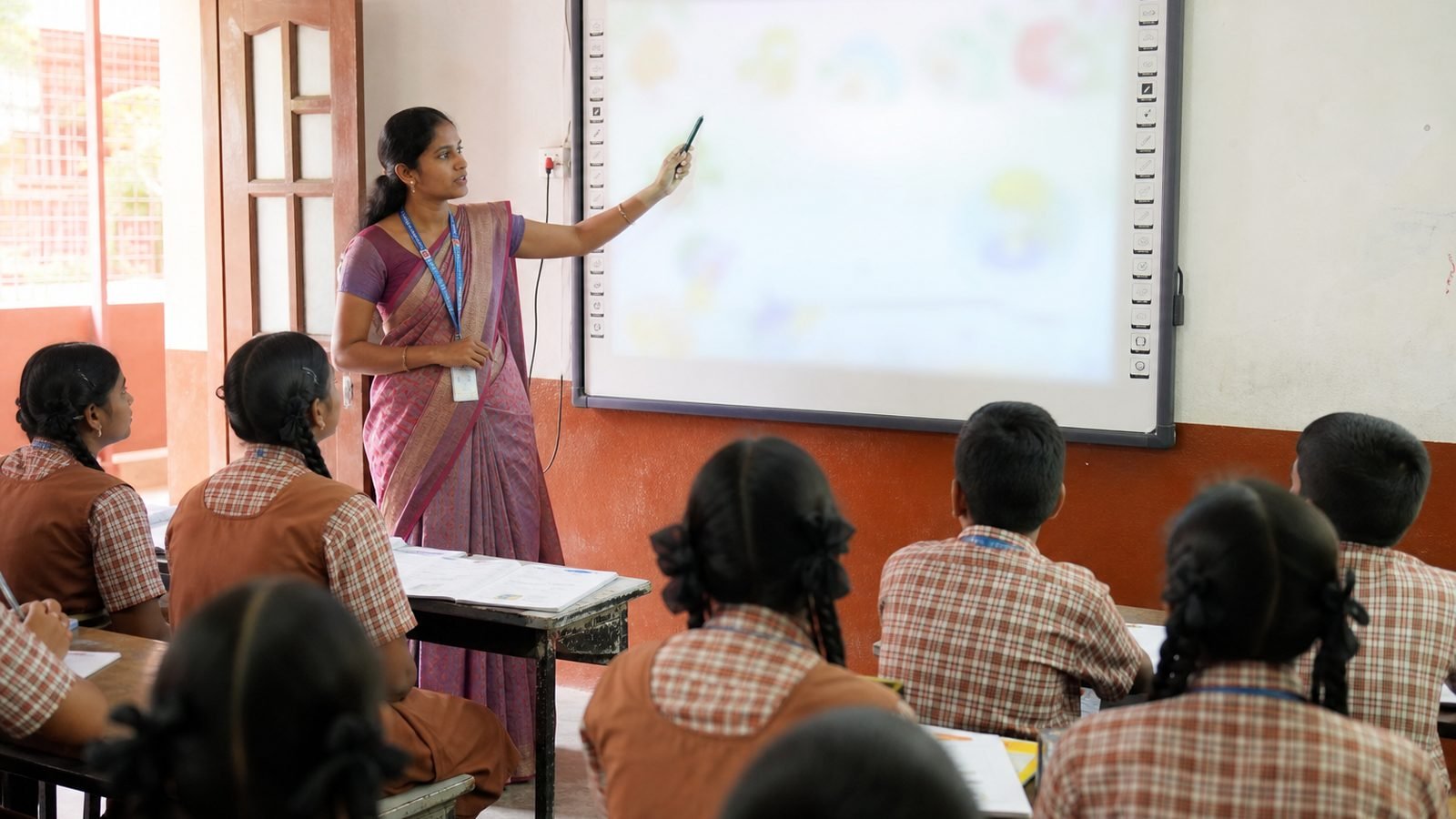
Smart classrooms have become common in schools; using them well remains rare. Technology in a classroom is a tool, not a teacher — and like any tool, its value depends entirely on the hands that hold it. At Kranthi High School, our digital learning environment is built around one question: does this help a child understand something more deeply than the alternative?
Where Technology Genuinely Helps
Some concepts are simply hard to convey in chalk. The rotation of planets, the growth of a seed, the flow of electric current, the geography of a river delta — these are dynamic processes, and animation shows what description struggles to. Visual and interactive content also reaches students whose learning styles are poorly served by lecture alone. A child who tunes out of a spoken explanation may lean forward for the same idea told through motion and image.
Technology also lets teachers respond quickly. A doubt raised in class can be answered with a real example on screen; a difficult problem can be reworked step by step for everyone to follow. Lessons become conversations rather than monologues.
Where Technology Cannot Help
No screen teaches a child to persist through a hard problem, to form an argument, or to write a clear sentence. Deep learning still comes from effort: working exercises by hand, reading, discussing, making mistakes, and correcting them. This is why our smart classrooms supplement — and never replace — the teacher's explanation, the notebook, and the practice that turns exposure into mastery.
We are equally deliberate about what we avoid. Passive video-watching is not teaching. Flashy content that entertains without instructing has no place in a lesson. And screen time at school is bounded, because childhood attention is a finite and precious resource.
The Teacher Remains the Centre
The most sophisticated equipment in any classroom is still a good teacher who knows each child by name. Our teachers decide when the screen serves the lesson and when it should stay dark. They pair digital demonstrations with questioning, discussion, and written work, so that what is seen is also thought about, spoken about, and remembered.
Preparing Digital Citizens
Beyond individual lessons, familiarity with technology is itself a life skill. Our students will study, work, and vote in a digital world. Learning to treat technology as an instrument for understanding — rather than a source of endless distraction — is a habit best formed early, under guidance. Alongside our computer lab sessions, students learn practical digital literacy: how to search well, how to evaluate what they find, and how to use devices purposefully.
The measure of a smart classroom is not the brightness of its screen but the depth of the understanding it leaves behind. Used with judgement, technology makes good teaching better — and that is exactly how we intend to keep using it.
Explore Our Programs Back to Blog